I was invited to join some friends at an exotic game ranch near Hondo, Texas to help hunt down and put down a large (approx 1500 pounds) female hybrid water buffalo (Asian with some % cape buffalo as the skin is black and the horns have some characteristics of the cape buffalo). She had a broken horn with no trophy value and had attacked an ATV, a truck, a feeder, ground blinds, and had chased some hunters on foot. I eagerly accepted as this would be a perfect opportunity to use my Winchester 1895 .405 to field test the North Fork 300 grain Cup Point Solids that I had loaded to a velocity of 2250 fps. This has worked out to be a good velocity for my 1895 as the North Fork 300 grain SS, CPS and FPS all shoot to the same point of aim as do the factory Hornady .405 ammunition.
When Ricky Krodle and I joined Joe Riekers, our friend and PH, at the ranch lodge, it was 5:00 PM of a sunny July Friday afternoon and the temperature was 105 degrees. We rested awhile and began hunting at 7:00 PM when the sun had begun to drop toward the horizon. It appeared the task would be easy, as we quickly located the ornery cow feeding with another buffalo and several other exotics. However, as we stalked through the sparse mesquite, the shifting light breeze caused some blackbuck does to spook and the buffalo saw us and trotted off into thicker brush before we could get a good shot. We then played hide and seek in the brush with the breeze and the buffalo until after 9:00 PM when it finally became too dark to hunt or shoot safely. Dusty, sweaty, and tired from hunting in the brush in 100 degree heat, we knocked off for the night and planned to resume our quest at daylight Saturday morning.
We were back at it at 6:00 AM and aided by cooler temperatures, a reliable and steady southwest breeze in our faces and a thick screen of brush between us and the buffalo, we were able to stalk to within 60 yards of them where they were feeding in the open with a mixed group of smaller game.
We eased out of the mesquite as the cow and another buffalo stood 50 yards away and within five yards of the thick brush. I was to take the first shot and because we had lost her the night before in the brush and did not get a shot, it was prearranged that after my shot, Joe (.375 HH) and Ricky (.348 WCF) would immediately fire. With our rifles at the ready, we were all prepared to fire and were just waiting for the intervening animals to clear away. Joe had prodded us into a skirmish line and he was whispering instructions as each critter moved about into and out of the line of fire. As the last one made it to safety and the buffalo cow lined up to follow, I remembered a suggestion Joe had made on a previous hunt “To get on target quickly, line up with the front leg and raise the rifle, fire as the sights reach 1/3 of the way above the brisket line” (not an exact quote, but the essence of the advice). I did exactly this and squeezed the trigger on my 1895; I saw that the 300 grain NF CPS hit right where I was looking and as the rifle recoiled, saw the buffalo begin to drop forward as if the right front leg had been swept away from it. As I levered in another round, Ricky and Joe fired in rapid succession and the buffalo kept falling down on its right front and it hit the ground like a sack of potatoes; its head hit so hard that dust flew from the impact. DRT was obvious, but we fired another volley into the brisket for insurance, took pictures, and the real work of field dressing and hunting for expended bullets ensued.

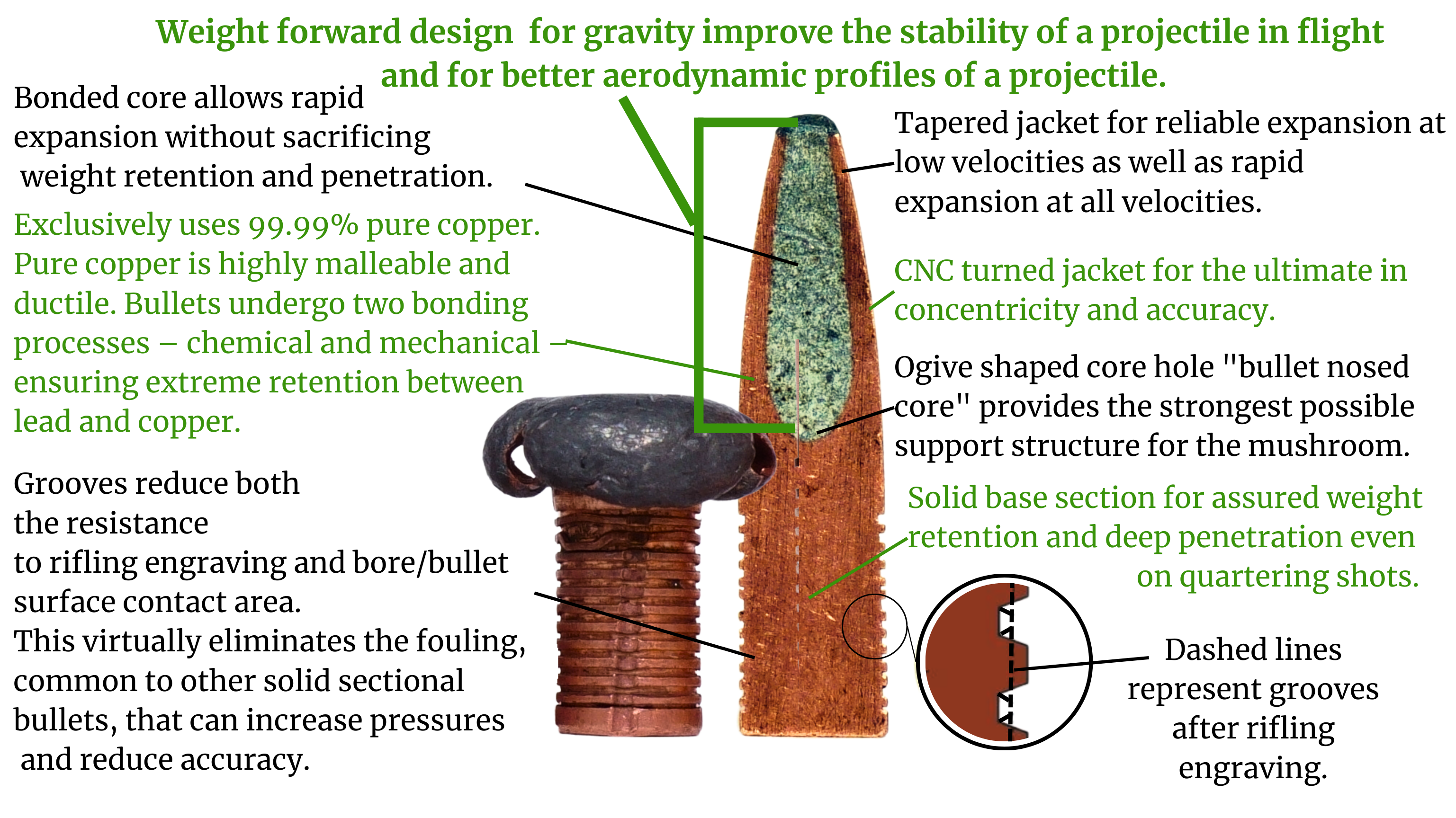
The post mortem was performed back at the game processing facility at the lodge and included the field inspection, searching for bullets during skinning and quartering and going over the gut pile with a metal detector to locate a final missing .375 bullet. It even continued on Sunday when my family was wrapping some of the meat. Most of the bullets were found with the exception of one shoot through. Though there was much to be learned from locating all the bullets and examining where they entered and finally came to rest, my focus was on my first shot. Here are the two North Fork bullets that were recovered - the shorter one was the first shot bone breaker and had been visibly compressed and mushroomed and had lost a few grains of weight down to 292 grains. The other bullet weighed 299 + grains and had mushroomed slightly.

My impression of the effect of my first shot with the .405 is based upon all the forensic information gathered and upon what I remember seeing. As stated, the 300 grain NF CPS hit the upper right leg bone and powdered it completely in two. It then passed through the right side rib cage, the internals (lung and heart?) and the left side rib cage, leaving a two inch hole in each rib cage and associated flesh. The bullet was found lying flat under the offside skin and may have made such large holes due to turning sideways when it decimated the leg bone. It was in a line to have hit the heart (there was one bullet hole in the heart), but whether it did or not, it did enough damage to put down and kill the buffalo.
All things considered, and in spite of some folks opinions that a 300 grain bullet is too light for such animals, I would gladly use this same trusted rifle/ammo combination (.405 300 grain NF CPS or FPS at 2250 fps) again on such a critter. Naturally, I want to be hunting with friends that I trust to help handle matters should they get out of hand. Also, there is no doubt that a heavier .405 bullet would have greater sectional density, could penetrate better, and might be more suitable for such large, tough game. I may work up such loads with heavier bullets, but DRT is still DRT and shot placement and premium bullets did make a difference.
The buffalo skull is now resting on a red ant bed by the road into the ranch where it will be apparent when the ants have it cleaned up and ready for display. I plan to pick it up when I return to Hondo to pick up my buffalo hamburger.
_________________
CRS, NRA Patron Member, TSRA, DWWC