


Chamois Hunt in Austria.
Read about Erik's exciting Chamois hunt in Austria.
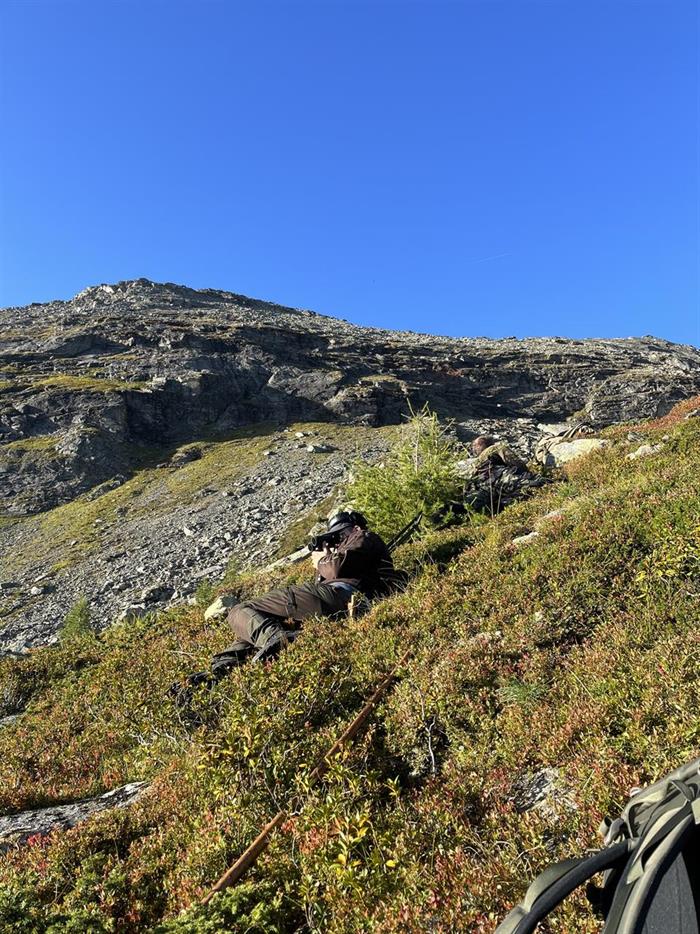
”Ok, let’s go for it.” I whisper to Uwe while looking through the monocular.
It is the same chammy that we have been spotting for over an hour while lying hidden in the thick heather and cloudberry which coats the mountainside at over 2,200 meters above sea level. When we first saw this chammy, Uwe correctly identified it as a female and since they usually have smaller trophies we at first decided to keep looking. Uwe and Tony have been scanning the mountains using their Swarovski binoculars and have with practiced ease identified chamois after chamois all morning. Most of them have been too far away to risk a shot and in our exposed position, moving about has to be considered carefully in order not to spook the chammy. All in all we have seen over 10 animals during the course of the morning.
Our lonely chammy female is standing about 400 meters away from us and at a position 200 meters higher than our current one. It has moved effortlessly and casually between a tiny fir and a group of small bushes, foraging in the morning sun. After studying it using his powerful monocular, Uwe declares that it is a very old female with only one horn. One-horned chamois are considered something special and not something that all hunters have the good fortune of finding, even after many years of hunting the alps.
The night before we had been talking about different trophies and what I was looking for, and in the typical Swedish manner I had responded that a “normal” trophy would be ideal. Not too small and not too big is what we Swedes call “lagom”, or translated to English – “just about right”. Uwe had responded that during our 2 days of hunting we would be sure to find any size of trophy I desired. But he had also asked what I thought about a one-horned chammy, and he explained that in Austria these are considered something special.
“A trophy with lots of character” as he put it. I hadn’t thought about the fact that chamois will occasionally lose one or both horns and that they never grow back. Just like a ram, they only get one set of horns a lifetime. Then and there I didn’t think much more of it – I was still picturing the perfect “lagom” trophy.
“That’s a great trophy” Uwe states and Tony, our companion guide and actually the owner of this piece of land, nods in agreement. It is an old female who has led a long and interesting life – “just think about the stories her horns would be able to tell us!” Uwe says. He hands me the monocular and I get an opportunity to see the chamois for myself. The way she moves around confidently shows that she has called these mountains her home for many years. Her fur is spotted with grey and white and the one horn she has is very long and narrow. Chamois grow their horns one fraction of an inch at a time and from the length of the horn it is clear that she is old.
“Ok, let’s go for it” I say, lowering the monocular. “Good choice” responds Uwe.
A few hours earlier we had started our climb in pitch darkness. “We have to walk fast now at the beginning” Tony says as we unload from the car at about 1,600 meters above sea level, having driven up winding mountains roads until arriving at a small farmstead, Tony’s family farm. The sounds of cows moving about in the darkness can be heard all around us and it is with certain trepidation that we get out of the car and get ready to start our climb. Our goal is to arrive at about 2,000 meters at day-break in about 1,5 hours and we are going to need all that time in order to silently climb up through the alpine forests. The path we are following is one that somebody not intimately familiar with the terrain would never be able to find.
The chamois lives high up, preferably around or above the tree line which in this area is located at about 2,100 meters. Chamois is part of the goat family and is also called the Alpine Goat or Antilope. Even thou they are not part of the antilope family. They can be found in most high mountain ranges on the south and east of Europe. In Austria the chamois, or “Gams” as it’s called in German, is considered one of the most challenging types of hunting due to the high altitudes and often long ranges that chamois is hunted at.
Spot and stalk is the only possible form of hunting and shooting distances often exceed 300 meters. For this very reason the Austrians tend to favour calibers which are small and fast, with the 7mm Remington Magnum, 7x64, 257 and 300 Weatherby being very popular choices. This is in stark contrast with Swedish hunting where larger and slower calibers and usually favoured and shooting distances rarely exceed 150 meters. I’ve brought along my favourite rifle, a Mark V chambered in 300 Weatherby. I am using a 200gr North Fork SS moving at 900 m/s and with a reasonable BC. After a few range sessions at the 300 meter range at home, I am not hesitant talking shots out at 300 meters or even a little beyond.
But that is precisely the reason I wanted to go to Austria to hunt in the first place. Since the chamois can only be hunted in its own environment and at its own terms it represents an unique challenge to hunt. The hunter needs to be both a good shot and be in good physical condition since getting to the hunting areas often require climbing hundredths of meters up steep slopes, sometimes angled at 45 degrees if not even more. “To hunt a chammy you need to be able to walk like a chammy”, Uwe explains, and I am inclined to agree with him.
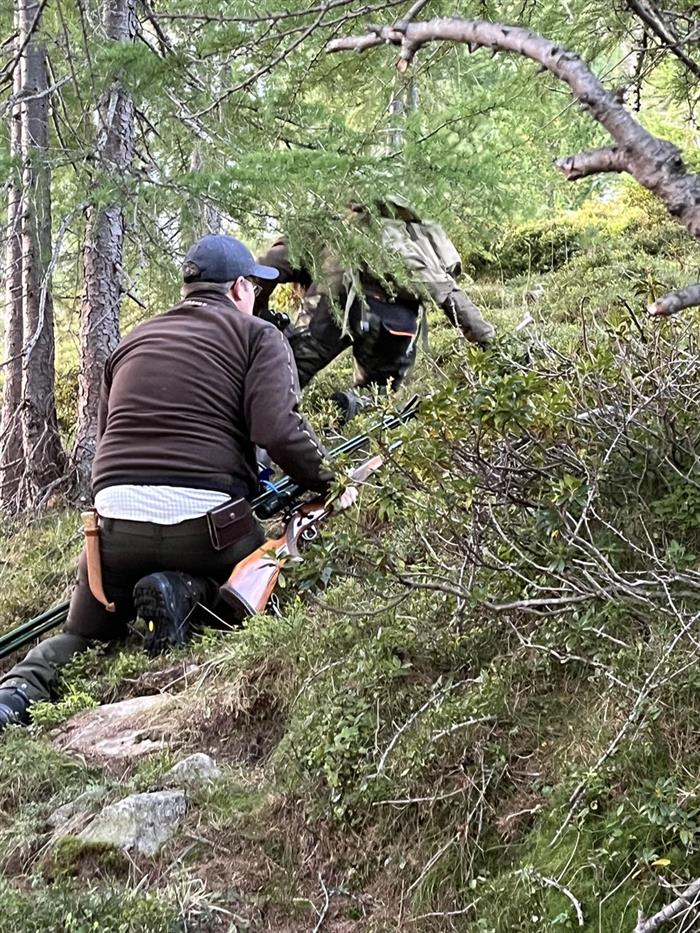
Of course I’ve also brought along a very nice double shooting stick with supports both in the front and the rear, bought specifically for this trip. “You’ve got the wrong kind of stick” Uwe factually declares as soon as he sees it. I protest weakly and mumble something about rear support being good for accuracy. “You need one of these” Uwe responds and hands me a classic Alpine walking stick, “it’s good for both shooting and walking”. I however refuse to yield, prompting Uwe to end the discussion with “Ok, you’ve got the wrong stick, I’ve got the right stick.” Events will prove him right since my adjustable four legged stick will prove difficult to walk with, be prone to folding up on itself and in the end we won’t use it. Trust your PH is usually good advice, as so also this time.
Climbing up the mountain is hard work and I can almost feel the air getting thinner with each 100 meters we climb. Both Tony and Uwe walk, climb and hop ever upwards at the same pace I would normally stroll down a city street and I am having some difficulty keeping up. Determined not to show any weakness I do my uttermost to hide my laboured breathing and do my best to keep my feet straight when putting them down upon not always solidly anchored rocks. Every broken twig underfoot and clattering of falling rock hangs embarrassingly in the morning silence.
Uwe and Tony occasionally whisper to eachother in the local Corinthian dialect, which seems only very distantly related to the limited schoolbook German that I know. As we start approaching the treeline, both guides stop more and more frequently to scan the mountainside using their binoculars. Finally we deviate from the path and lie down in the tall grass under one of the last clumps of fir trees. We are not far from the treeline.
“There is one!” Tony suddenly whispers back at us. I am looking through my binoculars furiously but am not able to see anything. After some more directions from Tony I am finally able to see the chammy, lying just in front of a rock at the very last trees. “That’s about 300 meters” Uwe says, using his rangefinding binoculars, “do you think you can shoot?”. Looking at the tiny chamois lying just below the big rock I start feeling a little bit out of my depth. I answer noncommittally that it would probably be better if we could move a little closer first.
We crawl down to the path again and continue upwards, taking a large detour around a small crease in the mountainside in an attempt to reach a higher spot without being seen by the chammy. Now daylight has arrived and we can just about sense the sun starting to rise from beyond the next mountain ridge over. We see lots of chammy droppings on our path and it is obvious that we have now arrived in the natural habitat of our quarry. Just as the sun breaks over the ridge at the opposite end of the valley, we pass the treeline and above us lies now only bare mountain.
The first chammy is long gone by the time we reach our stalking spot. We sink down into the deep heather and cloudberry brush, and I am finally able to catch my breath properly. I ask what altitude we are at and Uwe estimates it to about 2,200 meters. A few cloudberries will have to do for the breakfast we didn’t eat earlier. Over the next few hours we see many chammies, including the old female. We see a large flock of mothers and young, not for hunting, as well as a few lonely chamois. But all of them are either in the wrong place for a stalk or are too far away.
“I think it will be a difficult stalk” Uwe says when I ask about the old female at first. However, after looking at her trough the high power monocular we finally decide that she is the one. An old female who has done her part will not be missed by the herd and that also feels appropriate somehow.
“Ok, let’s go for it!” I say.
“We have to get as close as possible without spooking her, and that won’t be easy” Uwe says. The terrain between us and the chamois is entirely open and she is standing at about 400 meters above us, probably with a great view of where we want to cross. “Walk like a chamois” Uwe says and starts off across the rocky terrain. Hunched over double we stalk from one clump of rocks to another and slowly make our way across the open expanse of bare mountain side.
“Let’s move over to that large rock and try shooting from there” Uwe says and points at a very large rock. After a final dash across what looks like a dried out riverbed we are finally able to huddle up in cover behind the rock. Uwe peeks up and looks through his binoculars to confirm that the chamois is still there. She is. “Shall I use the shooting stick?” I ask, having carried the thing all this way. “No, much better to put the backpack up on the rock” Uwe responds. Taking off his small backpack Uwe places it on top of the rock and I hand him the rifle. Once he has confirmed that the positioning is good he gestures for me to take over.
Finally being able to see our quarry trough the riflescope, I get a clear sense of this being it. This is the moment I’ve spent months planning, waiting and practicing for. Nothing else remains but to align the sights and squeeze the trigger. The angle is a pretty straight 45 degrees upwards and the distance is measured at 217 meters. Quickly making some ballistics calculations in my head, I guesstimate that the angle of the shot will make just about make up for the bullet drop at this distance so I decide to hold right where I want the bullet. My scope only goes out to 8x and the sun is shining directly into it, giving a decidedly Instagram feel to my sight picture.
A good trigger needs to break just before the shooter anticipates it and mine is perfectly tuned. Aligning the sight, I break out one last time and start squeezing the trigger.
The shot breaks like a thunderclap and I immediately lose my sight picture with the recoil. Uwe is spotting through his binoculars. “You’ve hit her, she is very sick!” he says as I am desperately trying to find our chamois through the scope. I ask if I should shoot again and Uwe tells me to wait. Finally I manage to align the scope and I can see that the chamois is still standing up but isn’t moving. “Shoot again” Uwe says and this time I activate the fine trigger with a click. Putting the crosshairs right where I want to hit I exhale again. As soon as I touch the fine trigger the shoot breaks.
“Good job! You did it! She has fallen, it’s over. I am so happy that you could shoot!” Uwe exclaims happily. “Nice shooting, you’ve hit her twice.” Uwe gets up and gestures to Tony to start making his way over. While we wait Uwe explains that the worst situation for him is when the clients aren’t able to shoot since wounded animals aren’t easy to track and follow at these altitudes. We will later find out that my first shot went a bit low while the second was perfect. At these distances any little mistake on the part of the shooter will become exponentially more serious.
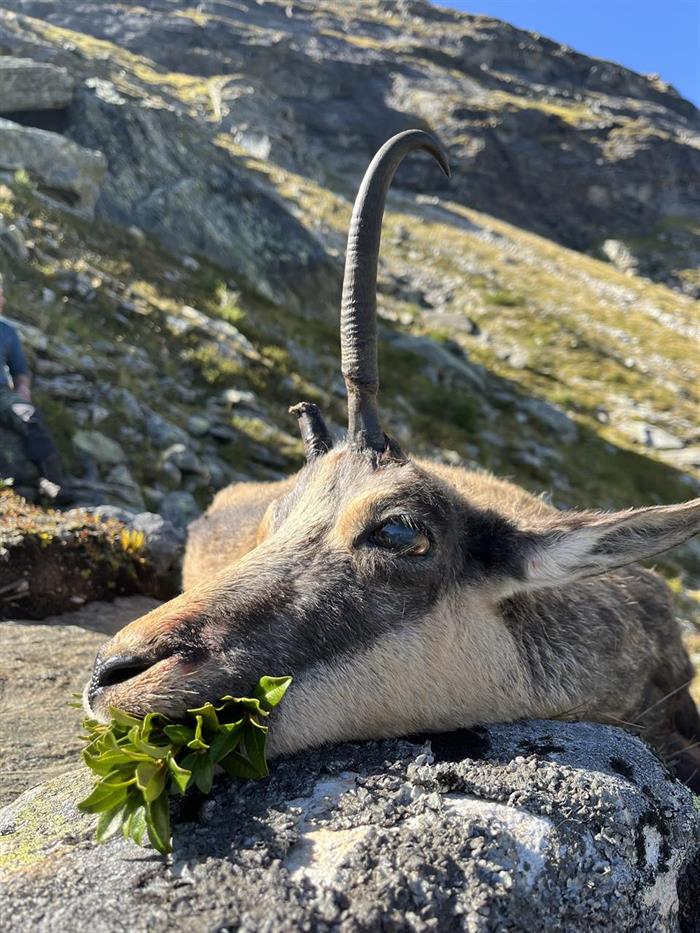
Together we climb up the slope to where the chamois is lying down. We give her the last bite, the tradition which dictates that each animal shall be sent off with a nice piece of branch or bush in its mouth. “Waidmannsheil!” Tony exclaims and at the same time hands me a glass of red liquid. It’s schnapps and together we drink the toast of the hunter. Waidmannsheil is the equivalent of “Cheers!” but only spoken between hunters after a successful hunt. “You need two legs to stand on.” Tony explains as he hands me a second glass and this one goes down smoothly and happily. Schnapps is by no means my first choice of beverage but at this moment, on this mountain it feels like the only possible choice.
When we examine the chamois we determine that it is indeed a very old female, maybe up to 15 years old. Chamois get yearly rings on their horns and by these you can estimate how old they are. But ours is so old that the latest rings blend together and become impossible to count easily. It is also evident that she lost her one horn long ago as the stump is well worn. Chamois use their horns for both foraging and fighting to they tend to get a bit beat up as the animal ages. We take our quarry and walk first down and then up again to a small hunting cabin located at about 2,400 meters above sea level. Looking at the location I carefully ask how it was built. “With helicopter – it’s the only way”. Tony explains.
It's now 12 o’clock and we have been at it for just about 6 hours since leaving the car. We are tired, hungry but content and happy with the days events. At the cabin Tony asks if he can have a shell casing for his collection and when we place it on the shelf I notice that it is not the first 300 Weatherby case in the collection. We sit in the sun and drink a beer, talking about the days events. Tony then packs the chamois in a very classical Austrian backpack and we start off down the mountain again.
Once we arrive at the farmhouse we are greeted by Tony’s father who has prepared a real hunter’s lunch for us. Dried meet, sausages, cheese and bread along with beer and more schnapps is served up. My schoolbook German is stretched to the absolute limit and in the end we manage to make ourselves understood with Uwe doing the occasional English translating when needed.
The chamois I have shot is what is called a “schadegams”, as “schade” is the German word for “too bad.” Uwe explains that the expression hints at the speaker saying “schade, ich wünschte, ich hätte es geschossen” or “too bad, I wish I had shot that one.” Inside the farmhouse there is a small trophy room containing a number of chamois trophies and in the central position among them all hangs two one-horned trophy’s next to each other.